In New York, curtains must do more than decorate a window. They may need to soften intense afternoon sun, protect privacy from neighboring buildings, improve bedroom darkness, or add acoustic warmth to a room with hard surfaces. The right design balances architecture, daily use, fabric performance, and installation constraints.
People searching for a Curtains company New York typically need more than ready-made panels. They are often looking for measured, fabricated, and installed treatments that suit apartments, brownstones, offices, hospitality interiors, or retail spaces.
A practical starting point is to define the room’s purpose, desired light control, and operating method before selecting fabric. SUPREME SHADES & DRAPES WINDOW TREATMENT SERVICE COMPANY DESIGN & INSTALL is one local service option clients may evaluate alongside other providers, with attention to design scope, measurement procedures, fabrication standards, and installation capability.
Tailoring Window Treatments to New York Interiors
New York interiors vary sharply within a few blocks. A compact Manhattan apartment may have floor-to-ceiling glass and limited clearance around radiators. A Brooklyn brownstone may feature tall sash windows, decorative moldings, and uneven plaster. Offices, restaurants, hotels, showrooms, and event venues introduce different requirements for durability, brand presentation, fire-safety documentation, and installation scheduling.
Several conditions influence the design:
- Ceiling height and window proportions: Mounting a rod or track closer to the ceiling can visually increase height, while extending it beyond the window frame allows panels to stack clear of the glass.
- Architectural trim: Deep moldings, radiator covers, baseboards, and window seats affect bracket placement, hem length, and whether a return or ceiling track is needed.
- Natural light: South- and west-facing windows may require solar filtering, blackout lining, or layered treatments to control glare and ultraviolet exposure.
- Privacy: Street-facing rooms and closely spaced neighboring buildings often benefit from privacy sheers, lined drapes, or dual-layer systems.
- Limited floor space: Stationary side panels, compact ripple-fold tracks, or roller shades paired with decorative curtains can preserve usable space.
Decorative curtains primarily frame a view and establish color or texture. Privacy drapes provide visual shielding, while blackout treatments reduce incoming light for bedrooms, media rooms, and hotel rooms. Layered window coverings combine functions—for example, a sheer for daytime privacy with a lined drape for nighttime darkness.
Custom Curtain Styles, Fabrics, and Hardware
The heading style determines how fabric hangs, stacks, and moves. Common options include:
- Pinch pleat: A tailored, traditional appearance that works well with rings, traverse rods, or decorative poles.
- Ripple fold: Smooth, continuous waves suited to contemporary interiors and ceiling-mounted tracks; it requires compatible carriers and precise fullness.
- Grommet: Metal or fabric-reinforced rings create a casual, modern look, although the rod must be strong enough to support the moving panels.
- Rod pocket: A simple sleeve conceals the rod but is generally better for stationary panels because frequent opening can be cumbersome.
Fabric selection involves both appearance and performance. Sheers diffuse daylight without fully blocking it. Linen-look materials provide relaxed texture but may wrinkle or require blended fibers for greater stability. Velvet offers depth, weight, and strong light absorption. Textured weaves can conceal minor handling marks, while performance fabrics are useful in busy commercial environments or homes with children and pets.
Lining changes the behavior of the finished drape. Standard lining improves opacity and helps protect the face fabric. Blackout lining substantially reduces light but can alter the drape’s stiffness and color. Interlining adds insulation and body, useful near drafty windows, though it increases weight and cost. Thermal performance matters in older buildings, but curtains should be considered supplemental—not a replacement for properly sealed windows.
Hardware is both structural and visual. Rods may be metal or wood; tracks can be wall-mounted, ceiling-mounted, manual, or motorized. Rings and carriers must match the heading style and fabric weight. Finials provide a finished appearance, while returns bring the panel closer to the wall and reduce side light.
Motorized curtains and shades are especially useful for tall windows, hard-to-reach openings, accessibility needs, and multi-window rooms. A professional specification should identify motor capacity, power source, control method, noise level, and integration requirements. Battery systems simplify retrofit work, whereas hardwired solutions may be preferable during renovation.
A Design-to-Installation Service That Fits the Project
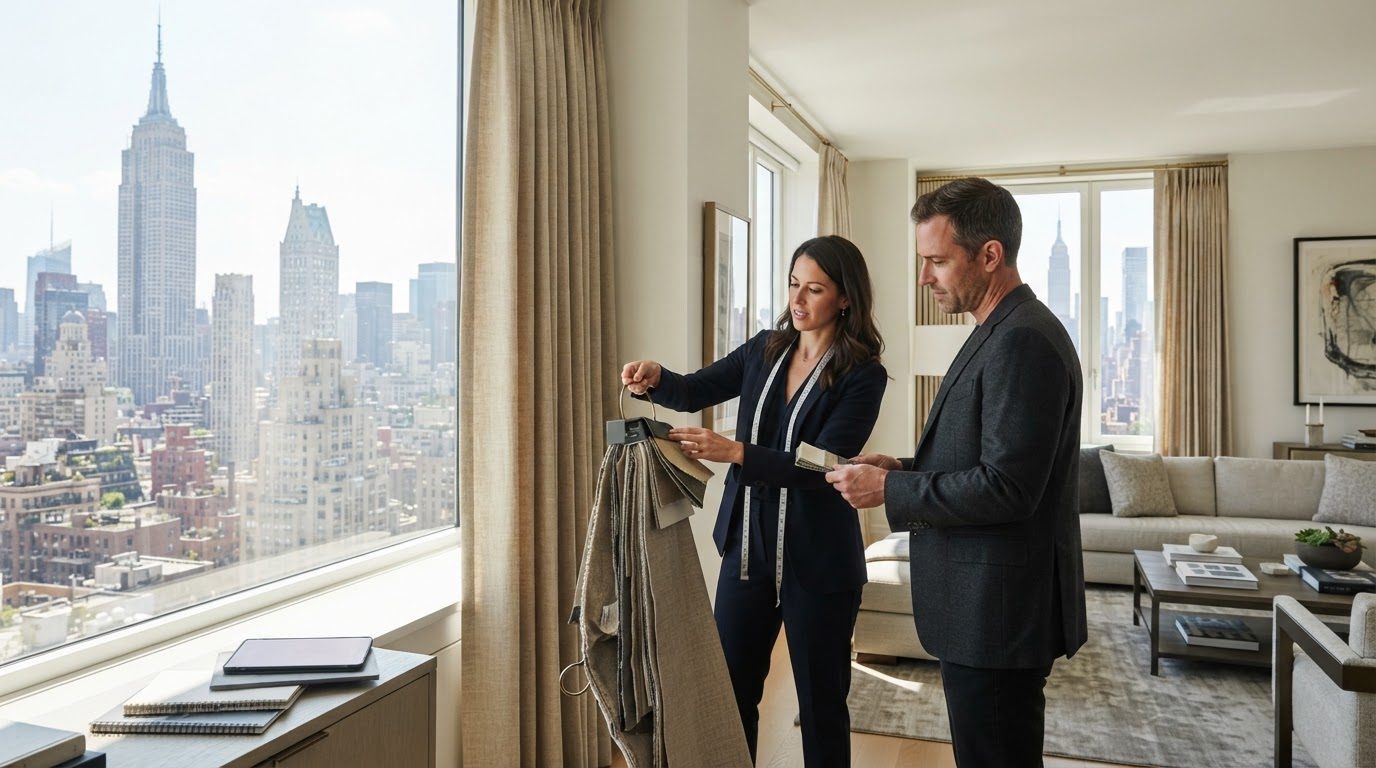
A reliable project begins with a consultation rather than a fabric catalogue alone. Clients should bring inspiration images, floor plans if available, photographs of existing furnishings, and a clear description of how the room is used. The designer should discuss privacy, glare, blackout performance, cleaning expectations, child safety, and whether the treatments must coordinate with shades or upholstery.
Professional measuring is particularly important for:
- Bay and bow windows.
- Tall openings and double-height spaces.
- Corner windows requiring passing or overlap arrangements.
- Multi-window walls where head and sill heights may not align.
- Recessed frames, curved walls, and openings affected by radiators or built-in furniture.
Measurements should document width, height, mounting surface, stack-back space, floor clearance, and obstructions. For commercial work, the process may also include reflected ceiling plans, finish schedules, mounting details, and coordination with electrical or sprinkler layouts.
Fabric samples, hardware samples, and design drawings allow clients to evaluate the complete direction before fabrication. Color should be reviewed in the actual room because daylight, LED lighting, and neighboring reflected light can change perception. Fullness—the amount of fabric relative to track or rod width—also affects price and appearance. Ripple-fold systems often use a defined fullness ratio, while pinch pleats require enough yardage to form consistent folds.
After approval, fabrication should include seam inspection, pattern alignment, hem review, heading verification, and hardware compatibility checks. Installation teams must account for elevator reservations, loading rules, narrow stairwells, building certificates of insurance, occupied rooms, and protected finishes. In hospitality or retail settings, phased installation may be necessary to avoid closing the entire space.
Residential and Commercial Drapery Applications
Residential Curtain Projects
Living rooms often use lined side panels or full-width drapery to soften daylight and visually frame the architecture. Bedrooms may require blackout lining, overlap at the center, and returns at the sides to reduce light leakage. Nurseries benefit from cordless shade systems or securely installed hardware, while home offices may need glare control for monitors and video calls.
Manhattan apartments frequently call for ceiling-mounted tracks, shallow returns, and treatments that work around radiators or limited wall space. Brooklyn brownstones may support more decorative rods and substantial fabrics, but older plaster and irregular trim make accurate anchoring essential. Dining rooms, libraries, and high-window apartments can use layered sheers and drapes to combine atmosphere with practical privacy.
Commercial and Contract Drapery
Commercial projects demand repeatability as well as style. Designers, architects, contractors, store planners, hotels, restaurants, lounges, showrooms, and event producers may require coordinated treatments across dozens of openings.
Important specifications include:
- Consistent finished lengths, pleat spacing, and color lots.
- Abrasion resistance, cleanability, and documented performance fabrics.
- Flame-retardant or other code-related documentation where required by the venue or authority having jurisdiction.
- Safe mounting, secure tracks, and appropriate controls for public areas.
- A delivery and installation sequence aligned with construction milestones.
Custom drapery can reinforce branding through color and texture, improve acoustics by reducing reverberation, protect merchandise from glare, and make guest areas feel more comfortable. In restaurants and hotels, the fabric must withstand frequent cleaning and high-touch use. In event spaces, quick opening, stacking, and reconfiguration may matter more than purely decorative detailing.
Planning a New York Curtain Project
Before requesting a consultation, prepare:
- Window dimensions, even if they are preliminary.
- Photos showing the entire wall, ceiling, trim, radiators, and nearby furniture.
- Room use and occupancy patterns.
- Desired privacy, glare, insulation, and blackout performance.
- Preferred style, colors, fabrics, and operating method.
- Target installation date and any building access restrictions.
Pricing varies widely. As a broad planning range, basic custom curtains may start around $1,000–$2,500 per room, while premium fabrics, substantial fullness, interlining, complex hardware, or large windows can bring a room to $3,000–$8,000 or more. Motorization may add roughly $500–$2,000 per opening, depending on the motor, controls, power, and integration. Commercial projects are typically quoted by scope, fabric yardage, hardware, labor, and quantity rather than by room.
Ask prospective providers:
- Who performs the site measure and verifies unusual conditions?
- Where are the curtains fabricated, and what quality checks are performed?
- What are the current lead times for fabric, hardware, and motorization?
- How many design revisions are included?
- What warranty applies to workmanship, motors, and hardware?
- What cleaning, maintenance, repair, and reinstallation services are available?
- Can the team supply insurance documents and meet condominium, co-op, hotel, or commercial building requirements?
New York’s dense buildings, older construction, strong seasonal sunlight, and demanding access rules make local project familiarity valuable. The strongest evaluation focuses not only on fabric selection, but also on measurement accuracy, transparent specifications, installation experience, and the ability to deliver a finished treatment that performs as well as it looks.